STYX: BLADES OF GREED – ADDICTED TO THE SHADOWS, PUNISHED BY THE LIGHT
Styx: Blades of Greed Review: A Flawed but Addictive Return to Classic Stealth
For fans of the pure, unadulterated stealth genre, the gaming landscape has felt somewhat barren in recent years. While many modern titles incorporate "stealth elements," very few commit to the hardcore, shadows-only philosophy that defined legendary franchises like Thief, Splinter Cell, or Metal Gear Solid. Enter Styx: Blades of Greed, the latest 2026 release from Cyanide Studio and publisher Nacon.
Priced at $49.99 for PlayStation 5 and Xbox Series X|S (and a slightly cheaper $39.99 on Steam), this action-adventure title promises a return to the golden era of sneaking. But does the foul-mouthed goblin stick the landing? After spending roughly 20 hours navigating its treacherous, semi-open-world environments, the answer is a resounding "mostly." Styx: Blades of Greed delivers an endlessly satisfying playground for stealth purists, provided you have the patience to look past its unwelcoming narrative and technical rough edges.
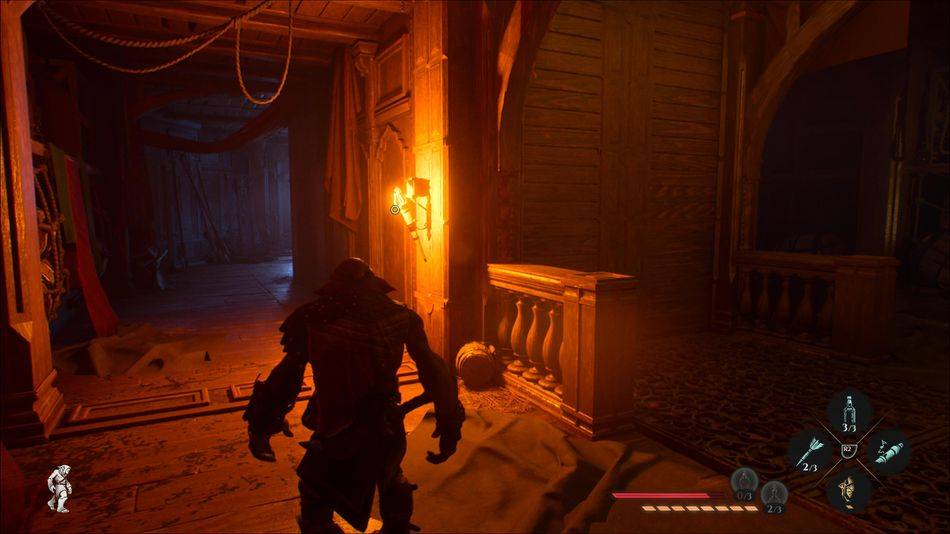
The Story: A Narrative Built for Veterans, Not Newcomers
If you are jumping into the Styx universe for the very first time with Blades of Greed, prepare for a severe case of narrative whiplash. The game suffers from a massive accessibility problem regarding its lore. Cyanide Studio seemingly assumes that every player is already intimately familiar with the world, its factions, and its history.
From the opening cutscene, you are bombarded with new characters, unexplainable political tensions, and distinct fantasy races without a single breadcrumb of context. You play as Styx, a uniquely intelligent, talking goblin with a penchant for sarcasm and murder. The plot revolves around his newfound obsession with "Quartz"—a mysterious, energy-emitting crystal. Upon interacting with this quartz, Styx absorbs its power, kicking off a compulsive quest to hunt down every last shard across the realm.
To achieve this, he builds a ragtag crew, including a human and an elf, who serve as the narrative axis for your missions. However, the game completely fails to establish why you should care about these characters. Who are they? What is their history with Styx? What exactly is the significance of the Quartz? For series veterans, this might be an exciting continuation of the goblin's saga. For newcomers, it is a confusing lore-dump that leaves a lot of potential emotional investment on the table. If you are playing strictly for a gripping, cinematic storyline, you will likely find yourself adrift.
Gameplay: A Masterclass in Shadow Manipulation
Where Styx: Blades of Greed completely fumbles its narrative, it entirely redeems itself in its gameplay. If you are a stealth aficionado, this game will sink its hooks into you and refuse to let go. It offers the kind of deep, mechanical engagement that modern gaming often lacks.
The Semi-Open World and The Zeppelin Hub
The game abandons strictly linear levels in favor of a semi-open-world design. Your base of operations is a massive Zeppelin, which you use to travel between several distinct, sprawling regions. Each of these regions is broken down into sub-areas, complete with unlockable Zeppelin stations that act as fast-travel points.
This design choice shines brilliantly when combined with Styx’s physical attributes. Because he is a diminutive goblin, the world is your playground. You aren't just hiding behind chest-high walls; you are crawling through tight crevices, scurrying through ventilation shafts, and utilizing extreme verticality to stay out of sight. The level design actively encourages you to look up, down, and around for alternative infiltration routes.
The Tools of the Trade
Styx's primary weapon is his trusty dagger, used for brutal, silent takedowns from the shadows. The core loop revolves around darkness management. You will extinguish torches, manipulate light sources, and carefully observe patrol routes.
But the dagger is just the beginning. As you collect Quartz shards and specific XP collectibles scattered throughout the world, you unlock a robust skill tree. The progression system is split into Talent points and Resonance points, which allow you to customize Styx to your preferred playstyle. You will unlock runes for passive buffs and discover blueprints to craft and upgrade a variety of lethal and non-lethal gadgets.
Do you want to ghost through a level without touching a single guard? You can. Do you want to meticulously assassinate every single enemy on the map and hide their bodies? You can do that, too. The game provides the tools, and the joy comes from executing the perfect, unseen heist.
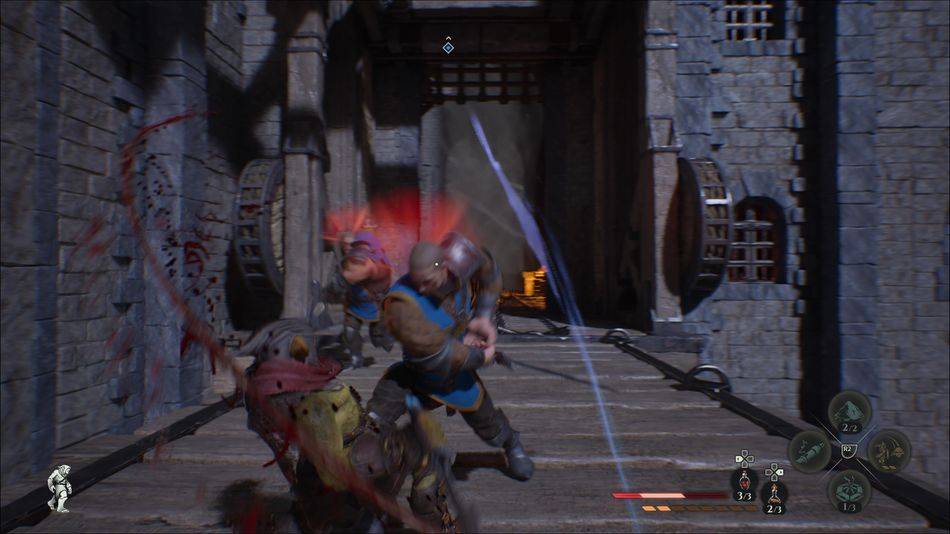
Combat and AI: Stay in the Shadows
Let’s be incredibly clear: Styx: Blades of Greed is not an action-brawler. While you can engage in face-to-face combat if you are spotted, you really shouldn't.
The "Do Not Fight" Rule
If you are caught by a single standard guard, you might survive a sloppy parry-and-strike duel. If two or more guards spot you, you are as good as dead. The game actively punishes you for breaking stealth, reinforcing the idea that Styx is an assassin, not a warrior.
This becomes even more apparent when facing specialized enemies. You will encounter heavily armored knights, rival elves, massive bugs, and hulking brutes. These elite enemies cannot be killed with a standard stealth takedown. Instead, the game forces you to get creative with environmental kills—like dropping suspended cargo crates on their heads or poisoning their food and water supplies.
The Bipolar Artificial Intelligence
Unfortunately, the stealth experience is occasionally marred by wildly inconsistent enemy AI. The guards in Blades of Greed alternate between being omniscient super-soldiers and absolute buffoons.
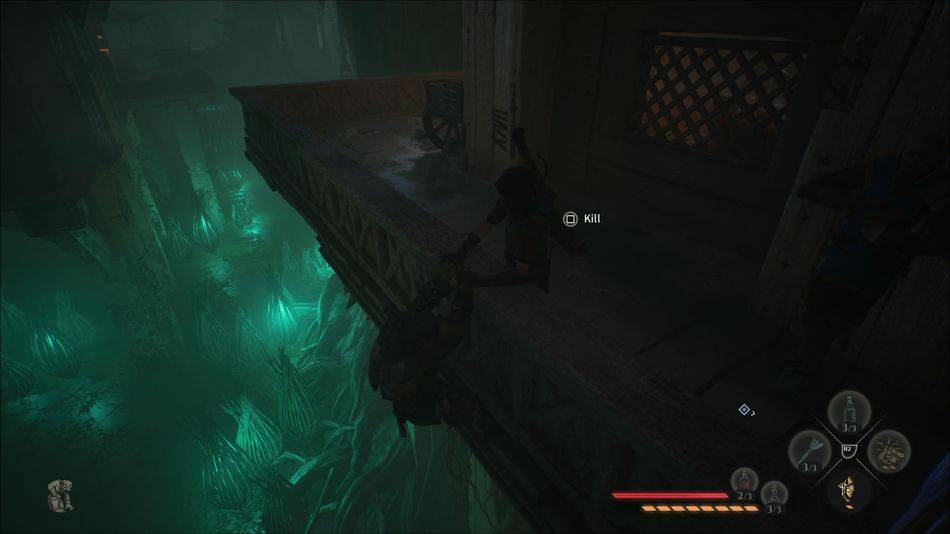
In one moment, an enemy might spot you through a solid wall or magically know exactly which barrel you are hiding in to poison you. In the next moment, you could be dangling from a ledge mere inches from a guard’s face, and they will stare blankly into the abyss. It isn't a game-breaking issue, but this unpredictability leads to frustrating, unearned deaths that can force you to reload your latest save.
Graphics, Performance, and Audio
Visually, Styx: Blades of Greed is a mixed bag that prioritizes atmosphere over high-end graphical fidelity.
The Beauty of Light and Shadow
The lighting engine is the absolute star of the visual presentation. In a game so reliant on hiding in the dark, the contrast between light and shadow is crucial, and Cyanide Studio nailed it. You never need an intrusive UI indicator to tell you if you are hidden; the environmental lighting naturally communicates your visibility. Extinguishing a roaring fireplace completely alters the mood and color palette of a room, casting beautiful, eerie shadows across the stone walls.
Technical Shortcomings on PS5
Sadly, the rest of the visual package feels noticeably dated. The most glaring issue on the PlayStation 5 is the texture streaming. Whenever a cutscene triggers or you enter a new sub-area, the textures take an agonizingly long time to load in, leaving environments looking muddy and low-resolution for several seconds.
Furthermore, the console version lacks modern graphical options—there is no toggle between "Performance" and "Fidelity" modes. The game aims for 60 Frames Per Second (FPS), but frequently fails to maintain it. In dense, heavily populated areas or during complex environmental interactions, the framerate can noticeably dip into the 30-40 FPS range. While not a dealbreaker for a slow-paced stealth game, it is a disappointment for current-generation hardware.
Sound Design
The audio presentation fares much better. The voice acting is remarkably strong, with Styx delivering his trademark cynical wit perfectly. The dynamic soundtrack is a highlight, specifically the use of a melancholic, soothing violin that swells and fades depending on your level of detection. It creates a tense, immersive soundscape that perfectly complements the gameplay.
The Final Verdict: Is Styx: Blades of Greed Worth Your Time?
Styx: Blades of Greed is a game of sharp contrasts. It is undeniably rough around the edges, suffering from a story that alienates newcomers, erratic enemy AI, and disappointing performance issues on modern consoles.
Yet, despite all of these flaws, it is incredibly difficult to put down. Cyanide Studio understands the fundamental mechanics of the stealth genre better than almost anyone else in the industry today. The level design rewards patience, verticality, and creative problem-solving. The core loop of upgrading Styx, manipulating the darkness, and silently picking off a fortress full of guards remains devilishly addictive.
If you are looking for a polished, cinematic narrative adventure, you should look elsewhere. But if you are a fan of classic, hardcore stealth games and are willing to forgive some technical jank in exchange for a deeply rewarding gameplay loop, Styx: Blades of Greed is a must-play.
Review Overview
- Pros: Incredible, old-school stealth mechanics; excellent vertical level design; satisfying skill progression and gadget variety; fantastic lighting engine.
- Cons: Narrative is confusing for new players; unpredictable and occasionally broken AI; texture pop-in and framerate drops on PS5; forced combat is clunky.
- Score: 7.5 / 10
Frequently Asked Questions (FAQ)
Do I need to play previous Styx games to understand Blades of Greed?
While the gameplay is easy to grasp, the story relies heavily on lore established in Styx: Master of Shadows and Styx: Shards of Darkness. Newcomers can enjoy the stealth mechanics, but the plot will likely be confusing.
Is Styx: Blades of Greed open world?
It is "semi-open world." You operate from a central hub (a Zeppelin) and travel to large, sprawling, interconnected regions, but it is not a single, seamless map like Skyrim or Elden Ring.
Can I play the game entirely without killing anyone?
Yes! The game fully supports a "ghost" playstyle, allowing you to bypass enemies using stealth, distractions, and environmental traversal without initiating lethal takedowns.